Expanding the impact of death

The posts this week engage with the question both of how the Civil War changed cultures of death, and how the experience (or, as Carolyn writes, the process) of death was changed by the ability of news and information to traverse space ever more quickly.  The flip-side is that people expected to hear news more quickly (or at all).  A really lovely articulation of this came in a story that Cordelia referenced:

The anecdote about the soldier who punished himself severely after not communicating to a dead soldier’s family of his death to be quite interesting as it was considered to him to be an absolutely heinous offense. In regards to information transfer, it was not the death that he felt bad about, but his lack of communication that gave him grief.

The idea of grief also comes into play here. Historians of emotion have spilled a lot of ink on the question of whether people in the past experienced emotions the way we do and simply called them different things, or whether they experienced things qualitatively differently.  Alec begins to grapple with these questions in his post, and will, I think, explore them more in his final project.

Technologies of War

Today’s reading is all about technology and war.  In class, we’ll be considering whether enslaved people, fires, railroads or even letters can be considered technologies of war, but I wanted to pick up on something Alec said in his post.  He notes that the ease of access to information today fundamentally changes our reading on disasters and ruin – “video cameras and high-def, color photograph….create more vivid and realistic representations of destruction.”  I think that this is an excellent point, but I wonder how people in the 19th century would have understood letters and newspaper accounts.  Not having access to “modern” technology, would they have considered such communiques the height of wartime communication technology?  In particular, I was thinking about this exhibit, which uses Neatline to overlay Civil War letters on the sites they describe.  This is an interesting way to combine modern and 19th century technology – and maybe worth pursuing for a final project like the one Kurt proposes?

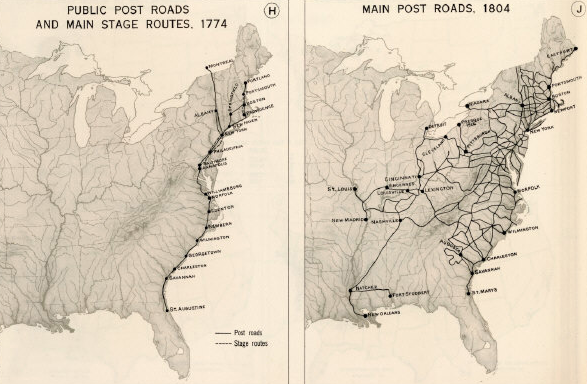
Others of you wrote about the Google doodle celebrating the Pony Express.  When I was a child, I remember being surprised that the Civil War and the Pony Express were contemporaneous events – they seemed to take place in two different worlds: one the battle-torn mid-Atlantic and Southern states, and the other the “wild” West.    Both Avery and Kurt commented on the utility of the Pony Express game for showing how essential communication and transportation were in 19th century America.  (For those interested in continuing a discussion about history and games, I hope you’ll stop by and chat with our visiting speaker – Meg Stivison – on Monday the 27th.)  Avery also rightly notes that by focusing on the Pony Express riders, we miss the story of those waiting for the mail.  Perhaps we can think about the game in the context of the post office map from a few classes ago, which showed how central post offices were – especially for life in the sparsely-settled American West.

Finally, Cordelia and Carolyn reported on the history presentations in Hance.  Both seemed taken with the work on the CIA in the first half of the twentieth century.  Kate LeGrand’s project takes the form of historical fiction (I assume that she is a student in Dr. Wertheimer’s class?) – I think that there are some interesting intersections between the historical methodology of writing fiction about the past and creating non-traditional historical works.  Both force the author to think about how the form of their project impacts the argument.  I want to close with a lengthy quotation from Carolyn’s post.  In response to a question about

“the value of presenting history with historically-accurate creative dialogue and characters that very likely could have existed, rather than presenting what is “known” to have happened in an engaging way. “

Carolyn reported that Kate

“Responded that the use of dialogue and a plot engages people with the subject of history who might never pick up a nonfiction text on the same subject. The dialogue particularly connects readers with the characters, and makes the historical events more lifelike.”

This is a very good point to take away as you start to plan and execute your final projects!

Internationalizing information and education

The readings for today come (or will come) after a discussion of national politics in the United States, but they remind us that politics, information and education in the mid nineteenth century was not bounded by national borders.  Thus far in the class we have been talking about American expansion into western space – space that was populated by Native peoples, Tejanos, Mexicans and the descendents of Spanish and French immigrants, but which was being claimed as American.  We’ve not spent much time talking about the other side of the Atlantic – an absence that is corrected this week.

Taking a transnational perspective on American information/knowledge/technology opens up some very interesting questions.  Carolyn makes a very interesting point about the didactic nature of the Chambers brothers’ publications.  I wondered how that educational impulse should change the way we read texts like those produced in the Chambers’ publications?  Do we think that American readers understood the educational impulse of the publications?  Did they mind?

Cordelia also reminded us that even as we attend to the transnational news economy, we must also consider the technological mechanisms that actually spread this news.  This reminded me of Eleanor’s primary source analysis, which interrogated the meaning of tracts printed in Britain, but read in North America.  As we move towards final projects, we should think about both the content and the form of information transmission.

Finally, I encourage everyone to read Kurt’s post from this week, in which he discovers a bit of railroad history in his backyard!

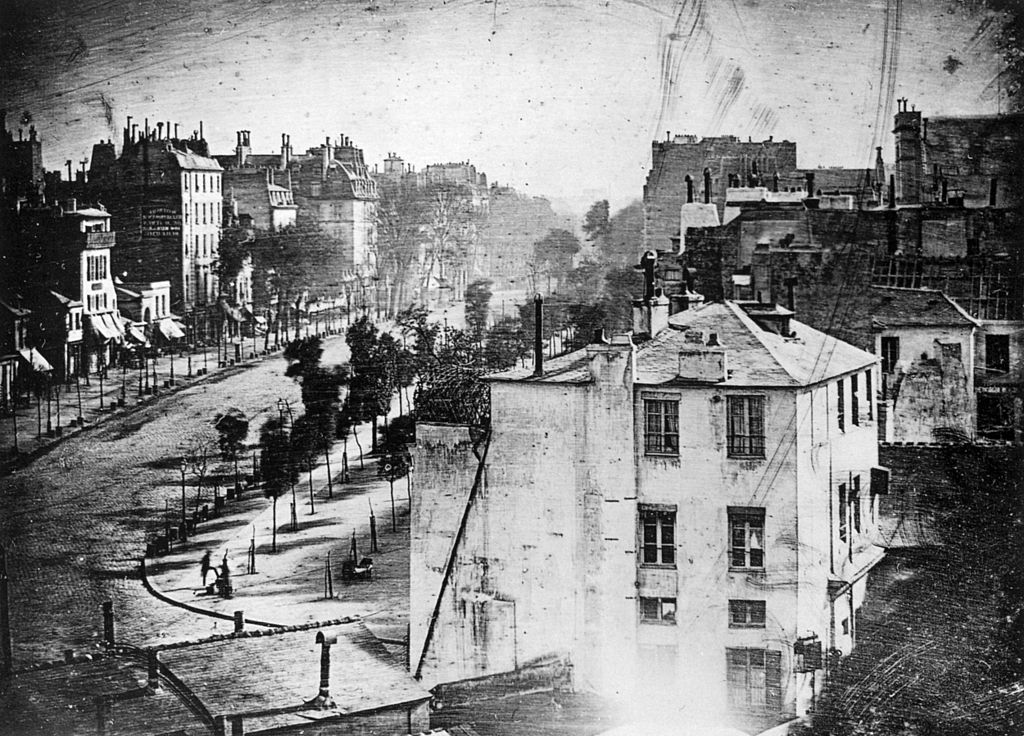
Drawing with light – the meaning of photography in antebellum America

In many ways, photography feels like a radical change from what came before.  Thinking back to our visit to the college art gallery, taking a photo with your phone, a digital camera or even a film camera seems like much less work than carving a wood block for a print, engraving a copperplate or setting up a lithograph.

In some ways, the Frank article reinforces this sense of radical paradigm shift, by highlighting the ways in which photography was a cultural touchstone for Emily Dickinson.  Carolyn rightfully notes that the emphasis on photography might be a way into 19th century ideas about living life in public or private.  She also noted that there might have been a gendered aspect to Dickinson’s aversion to photography:

It was perhaps accepted, if not encouraged, for men like Whitman to actively praise themselves; were a woman to have so enthusiastically thrust herself into the limelight, she might have been received to be unladylike.

Alec also brings up an aspect of Frank’s article that wasn’t fully developed – the physical significance of the daguerreotype.  Alec asks us to consider whether the reflectiveness of daguerreotypes was (to borrow modern parlance) “a feature or a bug” – that is, he

would guess that the mirror-like quality of the daguerrotype was more a product of technical limitation than a conscious attempt at creating a print that reflected its user.

Wilson also riffed on this theme, noting that, despite Dickinson’s poetic riffing on the idea of representing her image, photographs were qualitatively distinct from text.  He also raised the question of whether photographs are more “true” than other kinds of artistic rendering, suggesting on the one hand that the formality of early photographs robs the subjects of their individuality, but noting on the other that it was easier for Dickinson to shape her correspondent’s image of her textually than it would have been had she sent a photograph.

All three writers this week explored how the ascent of photography changed 19th century American culture – a theme we’ll continue to explore in class.

A systematic approach to studying technological change?

The readings for class today both (as Avery writes) come at the question of the history of telegraphy from two different directions.  One (Marvin) emphasizes the people who helped develop telegraphs – not the rockstars like Morse so much, but the engineers, operators and users who helped send information electroncially over vast distances.  The other (Stephenson) focuses on the technology itself, but also emphasizes the incredible contingency of the development of telegraphic lines of communication.

Avery nicely summarized the links between these two pieces when she wrote:

Ultimately, technology is a tool animated by us. (Perhaps that comes into question when we start talking about artificial intelligence, but by all accounts we’re a long way off from that.) At the same time, new technologies can transform the way we interact and the ways we imagine animating new tools. Marvin and Stephenson’s works bring these two fundamentally human aspects, culture and technology, together.

I, however, want to push their historiographical import a bit farther.  In her introdction, Marvin writes:

“[according to historians] everything before this artificial moment [the rise of appliances in the 20th century] is classified as technical prehistory, a neutral boundary at which inventors and technicians with no other agenda of much interest assembled equipment that exerted negligible social impact until the rise of network broadcasting.”

I wonder what all of you make of her historiographical positioning.  Was there a paradigm shift with the introduction of electronic communication?  Should we – as Stephenson does, and Marvin does less – contextualize modern forms of communication in light of their ancestors?


Maps as history; maps as argument

Last Tuesday and today are concerned with maps.  One of the turns in digital history is the acceptance of dynamic, interactive maps as a form of scholarship.  This can mean maps that tell a story (known as storymaps) or the datadriven maps that we looked at in class last week.

Carolyn differentiated between these two in her post.  She helpfully summarized Ben Schmidt’s argument/historical intervention as:

“Schmidt contends that the more important contribution of the historian is their assembly and unbiased interpretation of the evidence. I infer, then, that this is the theory behind Schmidt’s argument for digitization.”

However, she also questions Schmidt’s conclusion:

“First, if the historian’s most important job is to collect and present the information, what do we call the people who interpret that data? Second, why assemble data for the sake of assembling data – isn’t the “so what?” question, the participation in the discussion of live question, what makes history a worthwhile subject?”

For me, Carolyn,s questions raised further ones – are maps inherently objective?  Is the data that historians use cartographically any different from the data they use to write more “traditional” papers?

Wilson responded to Carolyn’s post by noting that Schmidt’s orientation of the map to the Pacific was in itself an argument –

“While doing so made my above observation about robust Pacific shipping connections more apparent, it did not seem to specifically focus on the trade with which the US was directly involved.”

Similarly, Alec noted that

“Maps, like any text, create arguments not just with the information they include but also the information they obscure and omit.”

Taking a different perspective, Sherwood posited that if the point of maps was to convey geographic information, maybe these are more dynamic representations than they are maps.

I will be interested to see how these ideas – about data as objective but maps as argument – are reconciled in class.

Both Kurt and Avery more directly took on the question of sources used in their map. Kurt rightly noted that the scale of the maps was not clear, and that

“First, we were wondering if this map dealt primarily with commercial shipping, or personal transit and travel. Also, we would have liked to know whether or not the experience a train ride chained dramatically with the change in travel times being so great”

Avery went further, suggesting that some historiographical context (or any context at all) would be helpful for a user understanding this map.  This is something to consider as you make your own maps – how much context is needed?  How much is too much?  How much is not enough?

Sherwood took a slightly different tack in one post, critiquing the architecture of Neatline itself.  His point is a good one – how much technical expertise is required to achieve a certain outcome?  How much should we expect humanists to learn new tools?

Finally, Cordelia makes a point that no one else did, but which is quite important – maps let us experience the past in new ways.  In her words:

[This map allowed the user] “to view historical events as they happen through the establishment of post offices. For example, the California Gold Rush is suddenly visible, as is the great Mormon migration to Utah.”

I look forward to thinking more about the multiple uses of maps in class today.

The utility of public spheres

This week was largely concerned with the African-American public sphere, and the ways in which participating in that sphere could be useful for people otherwise excluded from formal politics, but who did not want to, or could not, engage in violent rebellion.

The question of whether the public sphere is a useful concept, or whether having a public sphere was useful to enslaved and free people of color, was of concern to both Sherwood and Carolyn.  Sherwood – who was initially unimpressed by Habermas’s arguments – was persuaded of their applicability to this particular case. Carolyn was also persuaded, but raised concerns about the viability of Newman’s argument, given his occasionally bombastic language.

Avery linked the reading to our past discussions of autonomy and Native print culture.   I would encourage everyone to consider the viability of the concept of the public sphere to other situations we’ve discussed – and particularly to American Indian print culture – and to query the utility of “the public sphere” as a concept going forward.  In what situations is it useful?  Less useful?

css.php